
MBBS in China can be an option for Pakistani students planning to pursue medical education abroad. However, it’s important to research which scholarships are available before choosing a university, as tuition fees, accommodation, living expenses, and other education costs can vary widely.
Students looking for MBBS scholarships in China may have a few questions: Are fully funded scholarships available? Are Pakistani students eligible for a Chinese Government scholarship? Does the scholarship include tuition, hostel, and living expenses? Who is eligible, and how can they apply?
This guide aims to explain the primary pathways through which scholarships can be pursued, the distinction between fully funded and partially funded options, and the factors to consider, among other application steps that a Pakistani student needs to take before applying for MBBS in China. For a complete overview of university options, tuition fees, scholarships, and admission procedures, read our MBBS in China for Pakistani Students guide.
Are Scholarships Available for MBBS in China for Pakistani Students?
Scholarships in China are dependent on the University, academic program, scholarship scheme, applicants’ nationality, and admission cycle.
Pakistani students may explore the Chinese Government Scholarship and financial aid offered by universities. However, scholarship availability depends on the specific undergraduate medical course and entry requirements.
Not all Chinese universities provide scholarships to international students who are pursuing medicine, and not all scholarships are fully funded for MBBS students.
Before applying, students are advised to check:
- If it allows Pakistani students to apply for the scholarship.
- Whether undergraduate clinical medicine or MBBS is an eligible program.
- If the scholarship is available for international students.
- Whether the award covers tuition, accommodation, living costs, or only some of these costs.
- Whether there are any other tests, language requirements, or university admission requirements.
Students should also differentiate between admission to a Chinese medical college and a scholarship. These could be different application processes and selection criteria.
1. Fully Funded Scholarship for MBBS in China 2026–27:
A scholarship that pays for the full amount of the major expenses that have been approved by its terms is usually considered a fully funded scholarship. This could be tuition fees, accommodation, medical insurance, and a living stipend, depending on the scheme.
But the benefits of each scholarship and University differ.
Before considering any scholarship as a fully funded MBBS in China for Pakistani students, they should check the following:
Tuition fees: Does the scholarship cover the full yearly tuition fee for the medical program?
Accommodation: Is accommodation on campus offered, or is an accommodation allowance given?
Cost of living: Does the award provide a stipend for each month? If so, how much is it paid and for how long?
Medical insurance: Does it provide insurance, and what is covered?
Additional costs: Do application fees, medical exams, visa fees, airfares, books, and other costs not apply?
Scholarships can be awarded for tuition only, not for all living expenses. Likewise, an award might only be offered for certain programs or for certain academic years.
Students are therefore advised to request the official scholarship notification and written notice of the funding package before committing to any financial arrangements.
2. CSC Scholarship for MBBS in China:
The Chinese Government Scholarship (CGS) is a scholarship provided by the China Scholarship Council (CSC) for international students who meet the scholarship requirements to study in China during specific scholarship periods.
The Higher Education Commission of Pakistan has published information on the Chinese Government Scholarship for Pakistani Applicants.
Application routes and eligibility vary by scholarship category and intake. For instance, applicants choosing the HEC route must go through a nomination process, while those choosing other routes must follow the university and scholarship instructions.
Official information is available from the HEC Chinese Government Scholarship Program.
Can Pakistani Students Get a CSC Scholarship for MBBS?
The student should not assume that all undergraduate medical courses are eligible for CSC funding.
Contact the University’s international admissions office before applying and inquire whether the specified clinical medicine/MBBS program is eligible under the category of scholarships being considered.
Confirm these details:
- If the University accepts Pakistani applicants on the aforementioned scheme.
- Whether the particular medical degree is funded.
- If the program will be conducted in English or Chinese.
- If a preparatory language year is necessary.
- If a university application or pre-admission document is required.
- What academic documents, tests, and language certificates are needed.
An undergraduate program of study at a university does not automatically qualify you for an MBBS program.
HEC Chinese Government Scholarship: Important Application Details
According to HEC’s Chinese Government Scholarship page, the deadline for the 2026-27 cycle is January 5, 2026. As of October 2026, the deadline has passed.
Students considering admission should keep an eye on the latest official notification from the HEC; they should not rely on old deadlines or assume the application is open.
Applicants should carefully read the instructions published on the HEC portal and the CSC portal for the relevant HEC-administered route, including the required documents and undergraduate CSCA assessment requirements.
Before creating an application, read the latest instructions on the HEC scholarship program page.
3. University-Specific Scholarships for MBBS in China:
Some universities in China may offer their own scholarships, waive tuition fees, or provide other financial support for qualified international students.
These opportunities are not related to any specific government’s scholarship program. Availability, amounts, and eligibility requirements vary by University and intake.
Students should research when looking into university-specific scholarships:
- Eligibility of new international undergraduate medical students.
- If the award is for the whole degree or one academic year.
- Whether the award is based on academic achievement, financial need, or another selection method.
- If there are any academic standards which students are required to meet to obtain funding.
- If the award will be available in addition to other financial help.
- Whether the University has its own scholarship application.
Students must get the most recent information regarding the scholarships directly from the University. Don’t assume every Pakistani is eligible for a scholarship advertised for International students, or that it applies to clinical medicine.
4. Eligibility Criteria for an MBBS Scholarship in China:
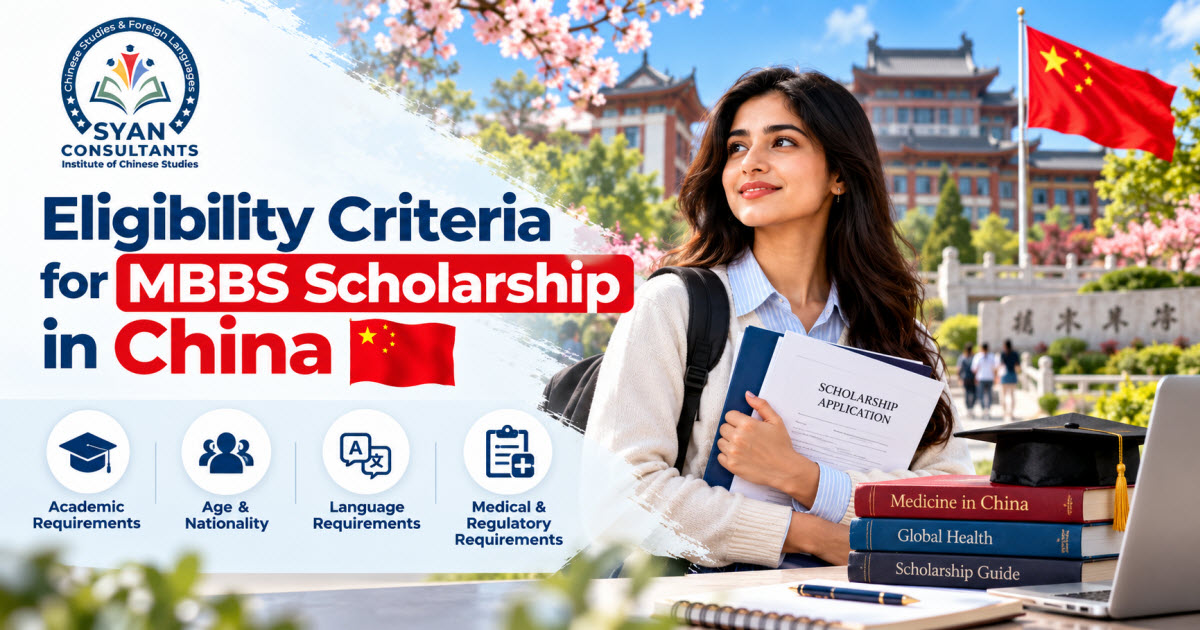
Eligibility for the scholarship does NOT imply eligibility for admission to the University.
Requirements for a specific award may vary from those for admission to the medical program.
Academic Qualifications:
In Pakistan, students usually check eligibility based on their FSc Pre-Medical, A-Levels, or other equivalent qualifications.
Qualifications, subjects, and minimum academic performance required are specified by the university and scholarship provider. Applicants are advised to refer to the specific requirements of the program and intake they wish to apply for.
Nationality and Age:
Some government scholarships have nationality and age criteria. For instance, HEC has released the Undergraduate Eligibility Requirements for the Chinese Government Scholarship regarding the age and nationality of candidates from Pakistan/AJK.
It is recommended that applicants read the most recent official announcement, as requirements may vary from one scholarship scheme to another and from year to year.
Language Proficiency:
Students need to determine if the medical course is taught in English, or whether they need an English language certificate, or a Chinese language qualification/preparatory course.
English-medium program can still have Chinese language learning for communication and clinical situations.
Medical and Regulatory Requirements:
The applicants are also required to research the medical education and registration qualifications applicable to Pakistani students undertaking medical education overseas.
This does not mean that if a university admits a graduate, they will automatically be eligible for medical registration in Pakistan.
You can find our MBBS in China Eligibility Criteria for Pakistani Students guide for the separate university admission requirements.
5. How to Apply for an MBBS Scholarship in China from Pakistan:
Applications depend on the scholarship type and University. Here are a few practical steps to get started.
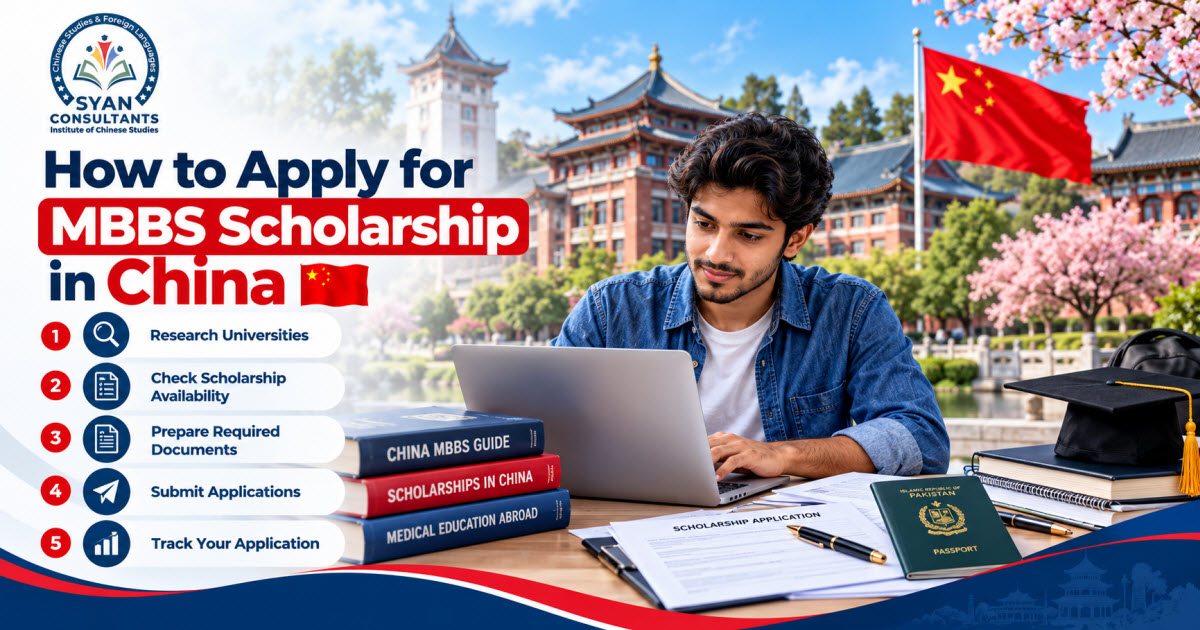
Step 1: Research Eligible Universities:
Check which medical universities offer the course you want to study. Refer to the up-to-date information on the University’s admissions, language of instruction, academic requirements, and relevant regulatory status.
Don’t just choose a university because of a low fee or a scholarship.
Step 2: Confirm Scholarship Availability:
Check with the University or the relevant scholarship authority whether the particular MBBS program is eligible for funding for the desired intake.
Inquire about the official scholarship rules, what the scholarship covers, the application deadline, and how students are selected.
Step 3: Check Admission and Scholarship Eligibility:
Review the requirements for your academic background, nationality, age, and language qualifications.
Also check for any relevant exams, such as the CSCA (if applicable), along with current PM&DC guidelines for medical education students from Pakistan.
Step 4: Prepare the Required Documents:
Documents can vary with the application and include:
- Passport.
- Matriculation, Intermediate, or equivalent academic certificates.
- Academic transcripts and mark sheets.
- Any required translations or attestations.
- Language proficiency evidence (if applicable).
- Medical examination documents.
- Scholarship application form.
- Study plan/personal statement (if required).
- University pre-admission documents (if required).
- Test score report or other documents required by the scholarship provider.
This is a generic list; it may include other items. Follow the instructions of the respective scholarship and University.
Step 5: Submit the Correct Applications:
Some scholarship courses require two applications: one with the government or nominating agency and another with the CSC or University.
If you are applying for the Chinese Government Scholarship, which is administered by HEC, please read the guidelines on the HEC and CSC portals.
Procedures may vary for other kinds of scholarships. Don’t assume that submitting an application to a university means you are entered into all available scholarship opportunities.
Step 6: Track Your Application:
Retain copies of forms, confirmation messages, and supporting documents.
Watch for emails or applications requesting extra information, interviews, decisions, or scholarships.
Step 7: Review the Final Offer Before Accepting:
If you do get an offer, make sure it states that you have been admitted to the University, that you have been selected for a scholarship, or both.
Read the award conditions carefully, including the amount covered, payment arrangements, time period, renewal requirements, and out-of-pocket expenses you will need to cover.
6. Does an MBBS Scholarship in China Cover All Expenses?
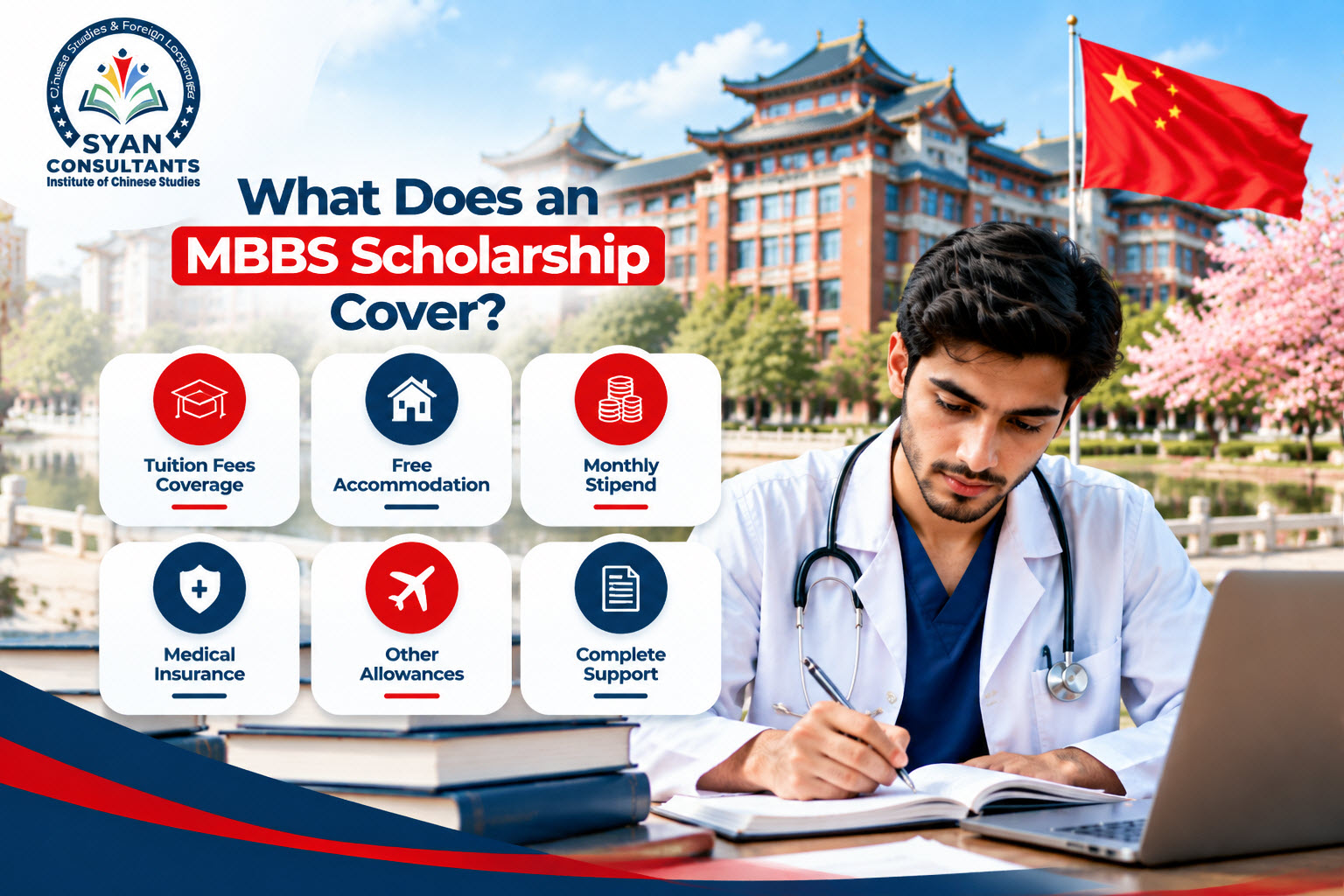
Scholarship benefits vary by scheme and university. Tuition, accommodation, stipends, and insurance are not guaranteed under every scholarship.
Not necessarily. Funding coverage varies by award.
| Expense | What to verify |
| Tuition fee | Is the complete fee covered or only part of it? |
| Hostel accommodation | Is a dormitory provided or an allowance offered? |
| Monthly stipend | Is a stipend included, and what are its conditions? |
| Medical insurance | Is insurance included in the award? |
| Food and daily living | Must the student pay these expenses separately? |
| Visa and travel | Are visa fees and flights excluded? |
| Other university charges | Are medical examinations, textbooks and administrative fees covered? |
Students should prepare a realistic budget even when applying for a scholarship. They should also establish what happens if funding is reduced, renewed conditionally or discontinued under the award rules.
7. Important: Check PM&DC Requirements Before Choosing a University:
Before enrolling in a medical program abroad, students planning to practice medicine in Pakistan should check the Pakistan Medical & Dental Council (PM&DC) requirements.
Admission to the University and eligibility for awards and/or professional recognition are distinct issues.
Before paying an admission deposit, investigate the current status of the specific institution and program, the relevant requirements for foreign medical education, and the applicable licensing pathway.
Consult the official PM&DC foreign undergraduate colleges information and the latest official notices.
It is not assumed that appearing on a Chinese list, receipt of a scholarship offer, or an admission letter by a university automatically means that an applicant is eligible for registration in Pakistan.
8. How Syan Consultants Can Help Pakistani Students:
Choosing a medical university involves more than finding a scholarship advertisement. Students need to understand the admission process, compare universities, review the costs and verify the requirements relevant to their intended career.
Syan Consultants can guide prospective students through relevant MBBS admission information, university selection, eligibility checks and application preparation.
Students can explore our MBBS in China admission guidance and services to learn more about the available support.
For university comparisons, our MOE Listed Medical Universities in China page provides a separate resource for researching medical university options. Students should still verify the applicable PM&DC requirements independently.
The number of scholarships available and the outcomes of admission applications vary by University and by the authority granting the scholarship. Students should not consider counseling or application assistance as a guarantee for a scholarship or for admission.
Frequently Asked Questions:
1. Is there a fully funded scholarship for MBBS in China for Pakistani students?
Availability of scholarships is subject to the University, program, and funding scheme. Students should confirm that the MBBS course is eligible and verify whether the tuition fees, accommodation fees, living expenses, and other charges are covered. A fully funded award should never be assumed unless officially confirmed.
2. Can Pakistani students apply for the CSC scholarship for MBBS in China?
The relevant official application channels can be explored to investigate opportunities for Pakistani applicants to apply for the Chinese Government Scholarship. Eligibility for a specific undergraduate medical program, however, is subject to confirmation with the relevant scholarship authority and University.
3. What is the deadline for the MBBS scholarship in China 2026–27?
Each scholarship has its own deadline. The HEC page for its 2026-27 Chinese Government Scholarship route has given the deadline as January 5, 2026, which has passed. Schedules may vary for other university or scholarship schemes. Please always refer to the most recent official announcement.
4. What documents are required for an MBBS scholarship in China?
Documents that are frequently requested are passport, academic certificates, transcripts, language evidence, medical examination documents, and scholarship forms. Other requirements, tests, and translations may be required.
5. Does the CSC scholarship cover tuition and hostel fees?
You can receive funding coverage only if it applies to your scholarship and you meet the award conditions. The details regarding the tuition, accommodation, insurance, and stipend benefits included should be checked by applicants from the official notice.
6. Is FSc Pre-Medical required for an MBBS scholarship in China?
The required academic qualifications and subjects vary by university and scholarship scheme. Pakistani students must check whether the program they want to pursue accepts FSc, A-Levels, or other equivalent qualifications.
7. Can I get an MBBS scholarship in China without MDCAT?
Don’t presume that the University’s admission policy answers this question. Pakistani students are responsible for verifying the current PM&DC requirements for the medical education route they wish to pursue abroad, as well as the separate requirements of the universities and scholarships.
8. Does a scholarship guarantee admission to a Chinese medical university?
No. Scholarship selection and university admission are separate processes with different conditions. Applicants are requested to verify both results with the appropriate officers.
Final Thoughts:
While the Chinese government offers MBBS scholarships, they may not suit every Pakistani student, and eligibility requirements and coverage can vary.
Before committing financially, first check the following: identify the universities offering your program of interest, then check whether scholarships are available for that program, and review the official application requirements and PM&DC requirements.
For a broader overview of studying medicine in China, including university options, tuition fees, scholarships and admission procedures, read our MBBS in China for Pakistani Students guide. For specific academic requirements, visit our MBBS in China Eligibility Criteria for Pakistani Students guide, or explore our MBBS in China admission services for university selection and application assistance.
2 Responses